DNS Security Automation: How to Manage DNS Policies as Code
DNS Security Automation in 60 Seconds
Manual DNS policy management doesn't survive contact with scale. Every organization that manages DNS security policy by hand, clicking through a console, copying blocklists between environments, remembering which exception was added for which project, eventually hits the same wall. Someone makes a change nobody reviewed. A block rule quietly reverts. Two regions run different policies without anyone noticing. This guide walks through what it actually means to manage DNS security as code: version controlling policy the same way you version control application code, using tools like Terraform to declare intended state, catching drift before it becomes an incident, building CI/CD pipelines that require review before a firewall rule changes, and automating the response loop between threat detection and policy enforcement. It also covers the pitfalls teams hit when they automate too fast, and a practical roadmap for getting started without breaking anything important along the way.
What You'll Learn
Manual Management Fails at ScaleConsole-driven DNS policy breaks down through unclear ownership, inconsistent multi-site config, slow incident response, and silent drift — all compounding as you grow.
Source of Truth is CodeYour configuration files are the actual policy — not documentation alongside it. Declarative tools like Terraform reconcile live state to match what's reviewed in version control.
Disciplined PipelineEvery change flows through plan → review → apply, giving it a permanent author, reason, and approval record — the same discipline already applied to application code.
Continuous Drift DetectionWithout scheduled drift checks, configuration files slowly stop reflecting reality — quietly undoing every benefit of managing policy as code.
Start Small, Automate DeliberatelyAudit first, prove the workflow on one low-risk area, then expand. Save high-leverage automations like automated threat response for after the team trusts the basic pipeline.
The Console Nobody Trusts Anymore
Ask anyone who has run DNS security for more than a year how confident they are in their current policy configuration, and you’ll usually get a pause before the answer. Not because the policy is wrong, necessarily, but because nobody is entirely sure how it got that way.
Somebody blocked a category eighteen months ago for a compliance audit that’s long since closed. A rule was loosened temporarily for a vendor integration that finished a year ago and was never rolled back. An exception was added at 11pm during an incident, by someone who has since left the company, and nobody remembers why it’s still there. Multiply that by every office, every subsidiary, every acquired company that got folded into the network, and you end up with a policy configuration that technically works but that nobody could fully explain if you asked them to.
This is not a failure of any individual security team. It’s what happens naturally when critical infrastructure is managed through a graphical console, one clicks at a time, by different people, over years, without a record of intent attached to every change.
“A console shows you the current state. It rarely shows you why that state exists, who approved of it, or what it looked like six months ago.”
Application teams solved a version of this problem a long time ago. Nobody on a modern engineering team deploys a production change by SSHing into a server and editing a file by hand. Changes go through version control, get reviewed by a second set of eyes, run through automated checks, and leave a permanent, searchable record of exactly what changed and why. That discipline is called infrastructure as code, and it has quietly become the default way serious engineering organizations manage everything from cloud networking to Kubernetes clusters.
DNS security policy has largely sat outside that discipline. It’s treated as a separate console, managed by a separate team, changed on a separate rhythm, often without the review process applied to everything else touching production. That gap is exactly what this guide is about closing.
We’re going to walk through what it means to manage DNS policy as code: not as an abstract engineering ideal, but as a practical, adoptable workflow that a real security team can run without turning policy management into a software project nobody wants to own. Settle in. This one covers a lot of ground, because doing this well touches version control, drift detection, testing, and the operational habits around all three.
A console shows you the current state. It rarely shows you why that state exists, who approved of it, or what it looked like six months ago.
What “DNS Policy as Code” Actually Means
Before going further, it’s worth being precise about the phrase, because “as code” gets used loosely enough across the industry that it risks becoming meaningless.
DNS policy as code means representing your DNS security configuration, meaning blocklists, allowlists, category filters, policy tiers, site assignments, identity group mappings, integration settings, as structured, version-controlled text files rather than as clicks in a web console. Those files describe the intended state of your DNS security posture. A tool then reconciles your live environment to match that intended state, applying changes automatically, flagging anything that doesn’t match, and refusing to apply a change unless someone has reviewed and approved it.
The most common way teams do this today is through Terraform, using a provider built specifically for their DNS security platform. You write a configuration file describing, for instance, that the finance team’s network segment should block newly registered domains, run stricter category filtering, and forward query logs to a specific SIEM index. You commit that file to a repository. A pipeline runs a plan, showing exactly what would change if that configuration were applied. A teammate reviews the plan the same way they review a pull request for application code. Once approved, the pipeline applies it, and the live policy now matches what’s written in the file, exactly, with a permanent git history recording who changed what and when.
That’s the mechanical description. But it’s worth sitting with what changes about how a team operates once policy lives this way, because the mechanics understate the impact.
First, every change has an author, a timestamp, and a reason, permanently. Not “someone probably changed this for the audit,” but a specific commit, by a specific person, with a commit message explaining why, sitting in history forever. Second, every change goes through the same review gate as everything else your engineering organization touches. A junior analyst can’t accidentally loosen a block rule on a production policy without a second person seeing the diff first. Third, and this is the part that tends to matter most in practice, your policy becomes reproducible. If you stand up a new site, a new acquisition, a new region, you don’t rebuild policy from institutional memory. You apply the same configuration files that already describe what “correct” looks like, and get an identical, tested outcome every time.
None of this is exotic. It’s the same discipline your platform team already applies to your cloud infrastructure. DNS security policy has simply been slower to catch up.
Why Manual DNS Policy Management Breaks Down at Scale
It’s worth being specific about exactly where manual management fails, because the failure modes are predictable and they show up in roughly the same order for almost every organization.
It breaks down first at the “who changed this” question. A console typically shows you what the current configuration is. It rarely gives you a clean, searchable audit trail of every historical change with a reason attached. When something breaks, or when a security review asks, “why is this domain allowed,” the honest answer too often becomes a Slack search or a guess, rather than a definitive record.
It breaks down next to the environment. An organization running policy across a headquarters network, a dozen branch offices, and a fleet of roaming laptops need those policies to be consistent, except where they’re deliberately, intentionally different. Managed by hand, consistency erodes fast. One office gets a category exception nobody documents. A new site gets configured slightly differently because whoever set it up followed a slightly outdated internal wiki page. Six months later, nobody can say with confidence whether two sites are running the same policy or just similar ones.
It breaks down badly during incident response. When something goes wrong, speed matters enormously, and speed is exactly what manual, console driven changes struggle to deliver. Blocking a newly identified malicious domain across every site, every device, every policy tier, by hand, one console session at a time, takes time an active incident doesn’t give you. Automated policy management can push that same block everywhere in seconds, because it’s not waiting on a human to remember every place the change needs to happen.
And it breaks down quietly, over time, through drift. Drift is what happens when the live configuration slowly diverges from whatever anyone intended it to be, usually because of manual tweaks made under time pressure that never get reconciled back into a source of truth. A rule gets loosened during an outage and never gets tightened again. An exception meant to last a week is still there two years later. Nobody notices, because nobody is actively comparing the live state to any documented intent, because no clean documented intent exists anymore.
Every one of these failure modes has the same root cause. Policy exists only as clicks in a console, with no durable, reviewable, comparable record of what it’s supposed to be. Managing policy as code doesn’t eliminate the need for judgment or expertise, but it removes the ambiguity about what the current state is, who’s responsible for it, and whether it matches intent.
The Building Blocks of DNS Security Automation
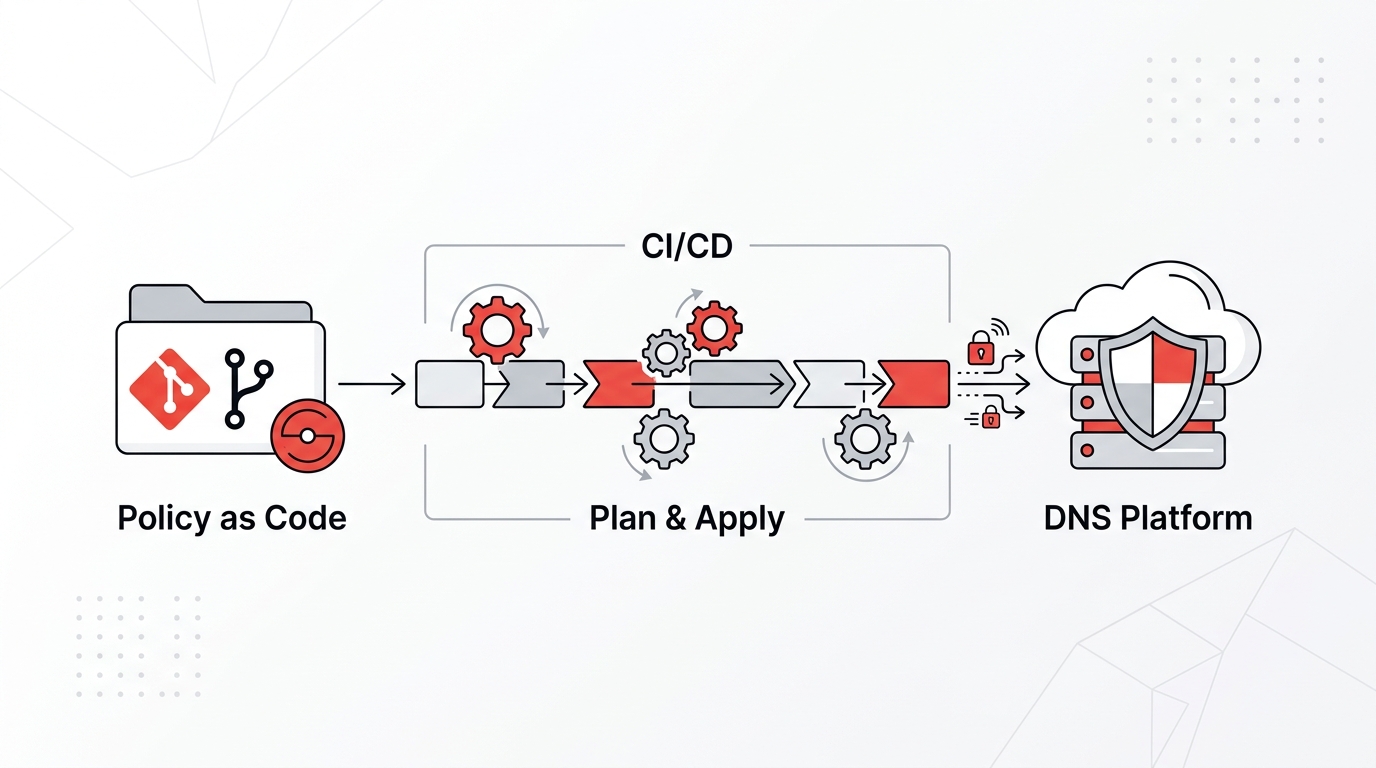
A working DNS policy automation setup is built from a handful of distinct pieces, layered together. Understanding each one separately makes the whole picture click.
🔌 A DNS security platform with a real API
Everything downstream depends on this. If your DNS security provider only exposes a web console with no programmatic way to read or write policy, none of what follows is possible. A REST API covering policies, blocklists, sites, identity mappings, and integrations is the foundation everything else builds on.
🏗️ An infrastructure as code provider
Most commonly a Terraform provider purpose built for the platform, translating structured configuration files into API calls, tracking state, and calculating exactly what needs to change between the current live configuration and the one described in your files.
🗄️ A version control repository
Where your policy configuration files live, usually the same platform your engineering team already uses. This is what gives you history, blame, branches, and pull requests for policy changes, the same tooling already trusted for application code.
🤖 A CI/CD pipeline
The automation layer that runs a plan on every proposed change, requires approval before anything gets applied, and executes the apply step once approved, removing manual, and hoc application of policy changes entirely from the equation.
🔍 Drift detection
A scheduled or continuous check comparing the live state of your DNS security platform against what your configuration files say should be, flagging any divergence so it can be investigated and either reconciled into code or explicitly reverted.
🧠 Threat intelligence and identity integrations
The upstream and downstream connections, threat feeds that can trigger automated policy updates, and identity providers like Entra ID, Okta, or Google Workspace that let policy be expressed in terms of users and groups rather than static IP ranges.
None of these pieces are exotic on their own. Most security and platform teams already have equivalents for other parts of their infrastructure. The work is in connecting them specifically for DNS security policy and building the operational habits around using them consistently rather than falling back on the console the moment something feels urgent.
Declarative Policy: Describing What You Want, Not What to Click
One concept worth explaining clearly, because it’s genuinely the mental shift that makes infrastructure as code work, is the difference between declarative and imperative configuration.
⚙️ Imperative Approach
A list of steps. Click here, then here, add this domain, then that one, toggle this setting. It describes a process.
🎯 Declarative Approach
Describes an end state. It says, "this policy should have exactly these blocklist entries and settings," without specifying steps. The tool figures out how to make reality match.
This matters enormously in practice for one specific reason: idempotency. If you run a declarative configuration against your DNS security platform ten times in a row, you get the same result every time, because the tool is comparing intent against current state and only applying the difference. Run an imperative script ten times, and depending on how it’s written, you might duplicate entries, hit errors on things that already exist, or leave the environment in a slightly different state each time depending on where a failure interrupted the sequence.
For DNS security policy specifically, declarative configuration also solves a subtler problem: it becomes the actual source of truth. The configuration file isn’t documentation describing the policy. It is the policy. If someone wants to know exactly what block rules apply to the finance network segment, they don’t need to log into a console and click through settings. They read the file. That single change, treating the file as the real, authoritative description of intended state rather than a record kept alongside the real thing, is most of what separates teams that successfully manage policy as code from teams that half adopt it and end up maintaining two sources of truth that quietly drift apart from each other.
Version Control: Treating Policy Changes Like Code Changes
Once your DNS policy lives in files, the next question is where those files live and how changes to them get made. The answer, for almost every team that does this well, is the same version control system already used for application code.
This gets you several things at once, and it’s worth naming them individually because each one solves a real, specific problem teams run into with manual policy management.
You get a permanent, immutable history. Every change to policy becomes a commit, with an author, a timestamp, and a message explaining the reasoning. Six months later, when someone asks why a particular domain is allowed, the answer isn’t a guess, it’s a specific commit you can pull up and read.
You get branches and pull requests. A proposed policy change, say, tightening the block category for freshly registered domains across the whole organization, doesn’t go straight to production. It gets proposed as a change on a branch, reviewed by a teammate through a pull request, and only merged and applied once someone else has looked at the diff and agreed it’s correct. This is the exact review discipline application engineering teams have relied on for years, applied to a domain that historically skipped it entirely.
You get rollback, cleanly. If a policy change causes an unexpected problem, reverting isn’t a matter of trying to remember what the configuration looked like before and manually recreating it by hand. It’s reverting a commit, and reapplying the previous, known good state through the same automated pipeline.
And you get a natural audit trail for compliance purposes, which turns out to matter a lot more than most teams initially expected. When a compliance review asks for evidence of change control around security policy, “here’s our git history, showing every change, its author, its review, and its approval” is a dramatically stronger answer than “here’s a screenshot of the current console state.”
The habit that makes this stick, though, is discipline. Version controlling your policy files only delivers these benefits if changes flow through that process, every time, rather than becoming a backup record that someone updates after the fact once they’ve already made the real change by hand in the console. The moment a team allows itself an “emergency console change, we’ll backfill the code later” exception, that exception becomes the norm within a few incidents, and the whole discipline erodes.
Drift Detection: Catching When Reality Diverges from Intent
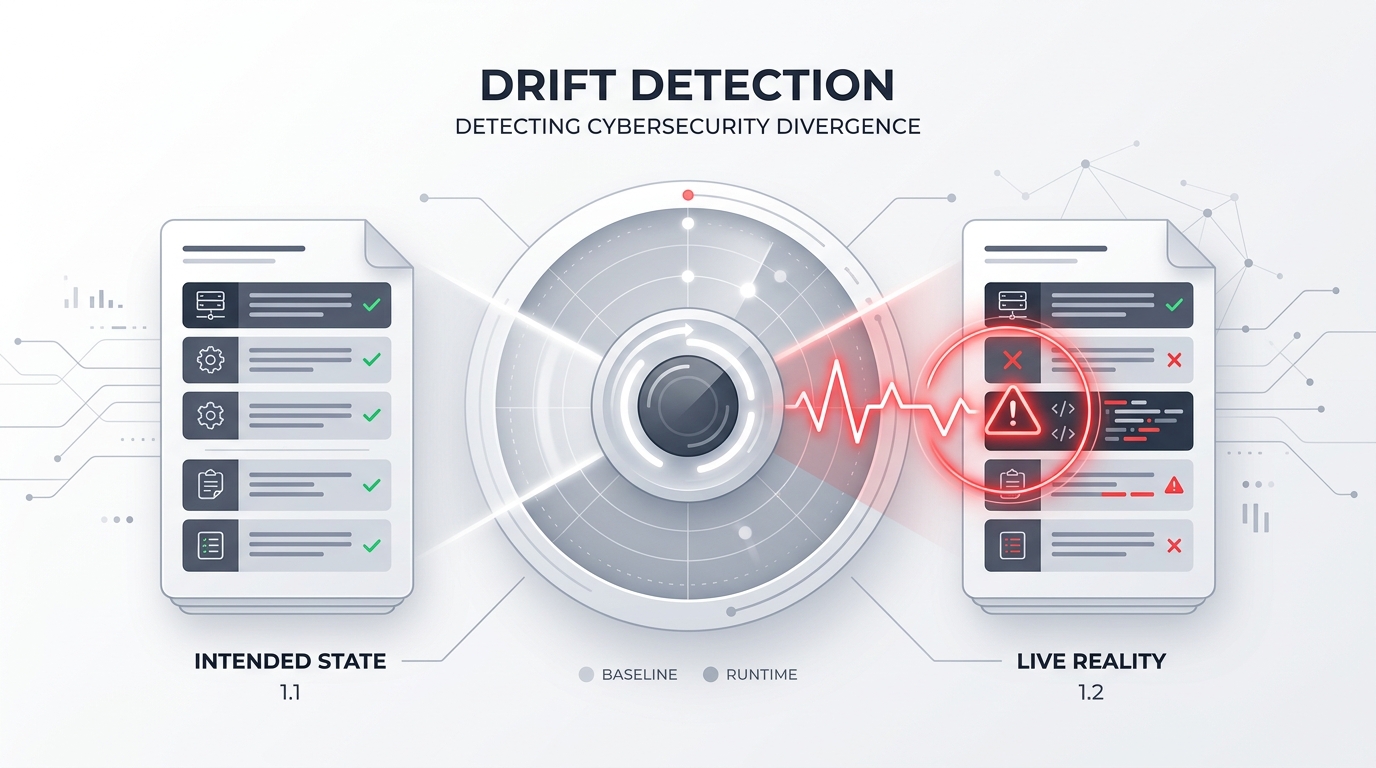
Even with discipline, code first workflow, drift happens. Someone makes a genuinely urgent console change during an active incident, correctly bypassing the pipeline because seconds matter more than process in that moment. A platform update introduces a new default setting nobody explicitly configured. An API call from a script outside your normal pipeline touches something it shouldn’t. Drift is not really a sign of failure. It’s an inevitability that any serious infrastructure as code practice has to plan for directly, rather than pretend won’t happen.
Drift detection is the practice of regularly, ideally automatically and continuously, comparing your platform’s live configuration against what your version-controlled files say it should be, and surfacing any difference. A modern Terraform provider for DNS security should support this natively: running a plan against production on a schedule, even when nobody intends to apply any changes, purely to check whether the live state still matches the declared state.
When drift is detected, a team has two honest options, and the wrong instinct is usually to silently pick one without deciding on purpose. Option one: the drift represents a legitimate, permanent change that should be adopted going forward, in which case the configuration files get updated to reflect the new reality, documented and reviewed the same as any other change. Option two: the drift is unintentional or was meant to be temporary, in which case the next apply reverts the live environment back to match the declared, intended state.
What you want to avoid is the third, unspoken option that quietly becomes the default in undisciplined environments: drift gets noticed, nobody does anything about it, and the configuration files slowly stop being an accurate description of reality at all. At that point you’ve lost the entire benefit of managing policy as code in the first place, while still carrying the overhead of maintaining files that no longer mean anything.
Good drift detection also does something quietly valuable for security specifically: it becomes a change detection mechanism. An unauthorized or unexpected modification to DNS security policy, whether from a compromised credential, an overly broad API token, or simple human error, shows up as drift the very next time the check runs. Treating drift detection purely as a hygiene practice undersells it. It’s also a security control.
CI/CD Pipelines for DNS Policy: Plan, Review, Apply
The operational core of managing DNS policy as code is the pipeline that connects your version-controlled files to your actual DNS security platform. A well-built pipeline follows a consistent, predictable sequence for every single change, without exception, and that consistency is exactly what makes the whole system trustworthy.
Propose Change
A change is proposed as a pull request against the policy repository, describing a specific, intentional modification (tightening a category, adding a site, updating an identity group mapping).
↓
Plan
A pipeline automatically runs a plan against that proposed change, calculating precisely what would be added, removed, or modified in the live environment if it were applied, without applying anything yet. That plan output gets attached to the pull request.
↓
Review
A teammate reviews the proposed change and the calculated plan together, checking that the diff matches the stated intent and that nothing unexpected is bundled into the same change.
↓
Apply
Once approved and merged, the pipeline runs the apply step automatically, making the actual change against the live platform, and records the outcome.
A few operational details separate pipelines that hold up under real pressure from ones that become a source of friction teams route around.
Safe mode matters enormously for production policy specifically. A pipeline should be able to flag certain changes, particularly anything that removes a block rule or loosen a policy tier for a sensitive network segment, for mandatory manual review, even if a general-purpose approval process might otherwise auto merge smaller, lower risk changes. Not every policy change carries the same blast radius, and a pipeline that treats them identically is either too slow for small changes or too permissive for big ones.
Speed matters just as much, particularly for anything tied to active incident response. A pipeline that takes twenty minutes to apply an urgent block during a live incident is a pipeline your security team will bypass under pressure, and every bypass chips away at the discipline the whole system depends on. Fast paths for urgent, narrowly scoped changes, like adding a single domain to a blocklist during active response, should exist and should still go through the pipeline, just with a review process proportionate to the low risk and high urgency of that specific kind of change.
And visibility matters for adoption. If the plan output is dense, technical, and hard for a reviewer to parse quickly, review quality degrades and people start rubber stamping changes they haven’t genuinely evaluated. Readable, clearly formatted plan output, showing plainly what’s being added, removed, or changed, is what keeps the human review step meaningful rather than ceremonial.
Automating Blocklists, Allowlists, and Threat Intelligence Feeds
One of the highest leverage places to apply automation specifically is the connection between threat intelligence and your actual block policy, because this is exactly where manual processes struggle most against the speed of modern attacks.
Consider what a manual workflow looks like for responding to a new threat feed update. Someone reviews a list of newly identified malicious domains, decides which ones are relevant, logs into a console, and manually adds each one to a blocklist, hopefully across every site and policy tier that needs it, hopefully without missing one. That process might take minutes to hours depending on team availability, and every minute matters against phishing infrastructure that might only live for a few hours in the first place.
An automated pipeline instead treats threat intelligence feeds as an input that can trigger policy changes directly. A new confirmed malicious domain, from an internal detection engine or a trusted external feed, generates a proposed change against the policy repository automatically, either applying immediately for high confidence, clearly malicious indicators, or opening for expedited review when the confidence signal is lower and a human judgment call adds real value. Either way, the change flows through the same version controlled, auditable pipeline as any manually proposed change, meaning even fully automated blocks leave a clear record of what was added, when, and based on what signal.
This same automation pattern applies cleanly to allowlists and exceptions too, which is worth calling out because exceptions are exactly where policy tends to accumulate the quietest, unreviewed drift over time. An exception request, someone needing a specific domain unblocked for a legitimate business reason, becomes a pull request with an expiration date built in, rather than a permanent console change nobody remembers to revisit. When the expiration date arrives, the pipeline can flag it for renewal or automatically let it lapse, closing exactly the kind of slow policy erosion that plagues manually managed environments.
Automating this connection between intelligence and enforcement is genuinely one of the more consequential things a mature DNS security automation practice does, because it directly addresses the speed gap that attackers rely on. Phishing kits and algorithmically generated malware infrastructure specifically exploit the lag between a threat becoming known and defenses updating to block it. Closing that lag from hours to minutes, or minutes to seconds, through automation rather than manual console work, is a genuinely material security improvement, not just an operational convenience.
Policy Tiers as Code: Encoding Risk Based Rules
Almost no organization runs one uniform DNS security policy across every part of the network, and for good reason. A finance team handling wire transfers reasonably warrants stricter policy than a general office network. A school network filtering for compliance needs different category rules than a hospital network worried about sensitive data handling. Managing that tiered structure by hand tends to produce exactly the kind of inconsistency and drift covered earlier. Managing it as code turns tiering into something explicit, reviewable, and reliably reproducible.
In practice, this usually looks like a base configuration describing sensible organization wide defaults, with additional configuration modules layered on top for specific groups, sites, or identity segments that need stricter, or occasionally more permissive, rules. A finance segment module might declare that newly registered domains under a certain age get blocked outright, that a stricter category list applies, and that query logs route to a dedicated, more closely monitored SIEM index. A general office module might apply looser defaults appropriate for broader day to day use.
Encoding tiers this way delivers a specific, practical benefit beyond just organization: it makes the actual risk posture of every segment of your network explicit and comparable, in a way that’s genuinely hard to achieve through a console where policies for different sites live in separate, disconnected screens. Anyone reviewing the configuration can see, directly in the files, exactly how the finance segment’s policy differs from the general default, and why, assuming commit messages and code comments are used the way they should be.
It also makes onboarding new sites or business units dramatically faster and more reliable. Standing up policy for an acquired company, or a newly opened office, becomes a matter of applying the appropriate existing tier module rather than rebuilding configuration from scratch or, worse, from memory of how it was done the last time. That reproducibility is one of the more underrated benefits of policy as code generally, and it compounds specifically as an organization grows and adds more sites, more acquisitions, and more distinct risk profiles that need to be managed consistently.
Identity and Group Based Policy Automation
Static IP based policy has an aging problem baked into modern network reality: IP addresses don’t reliably map to people or risk profiles anymore, particularly with remote work, dynamic addressing, and devices that roam constantly between networks. Policy that’s genuinely useful at scale increasingly need to be expressed in terms of identity, specific users and groups, rather than network location alone.
Automating this connection means syncing your DNS security platform with your identity provider, whether that’s Entra ID, Okta, or Google Workspace, so that policy tiers apply based on group membership rather than which physical network or IP range a device happens to be sitting on at a given moment. When someone joins the finance team, their DNS policy tier updates automatically as part of the same provisioning workflow that grants their other access, rather than requiring a separate, manual DNS console update that someone must remember to make.
This matters for security accuracy directly, not just administrative convenience. A finance employee working from a coffee shop on public WiFi should carry the same finance level policy tier they’d have in the office, not a looser default policy simply because they’re off the corporate network. Identity based policy, properly automated, follows the person rather than the location, closing a gap that purely network based policy structurally can’t close.
It also solves a real operational headache around offboarding. When someone leaves the organization or changes roles, identity synced policy updates or removes access automatically as part of that same workflow, rather than depending on someone remembering there’s a separate DNS console entry that also needs updating. Anyone who has run security operations for any length of time knows exactly how often that kind of manual, secondary cleanup step gets missed, quietly leaving stale access sitting around far longer than it should.
Automating the Response Loop: From Detection to Enforcement
Detection and enforcement are traditionally treated as separate systems, with humans bridging the gap between them. A detection engine flags something suspicious. A person reviews it. A person decides to block it. A person makes the change. Automating DNS policy as code opens the door to closing that loop directly, at least for the categories of threat where the confidence level genuinely warrants it.
A well-designed automated response pipeline typically ties its actions at a confidence level, rather than treating every detection identically. High confidence indicators, a domain matching a known, verified malicious pattern with strong supporting signals, trigger an immediate, automated block, applied through the same version-controlled pipeline as any other change, with a clear record of the automated decision and the signal that triggered it. Medium confidence indicators, something suspicious but not definitively confirmed, generate an expedited review request routed to an analyst, with the proposed block already drafted and ready to approve with a single action rather than built from scratch. Lower confidence signals simply get logged and monitored, feeding into pattern analysis without triggering any policy change at all.
This tiered structure matters because full automation without any confidence calibration is exactly how a system develops a false positive problem serious enough to get quietly disabled by a frustrated team. The goal isn’t removing human judgment from DNS security policy entirely. It’s removing human judgment specifically from the mechanical, repetitive, time sensitive parts of the process, the actual act of applying a well understood, high confidence block across every relevant site and policy tier, while keeping genuine judgment calls in front of an actual analyst.
Done well, this loop dramatically compresses the time between a threat becoming known and a network being protected against it, which, as covered earlier, is precisely the metric that matters most against fast-moving, short-lived attack infrastructure like phishing-as-a-service kits and algorithmically generated malware domains.
Multi-Site and Multi Region Policy Automation
Organizations operating across multiple sites, and increasingly multiple geographic regions with distinct data residency and privacy requirements, face a specific version of the consistency problem that manual policy management handles particularly poorly.
Managed by hand, an organization with fifty sites tends to end up with fifty subtly different policy configurations, not because anyone decided they should differ, but because each one was set up at a different time, by a different person, following slightly different institutional knowledge about how things are supposed to be done. Managed as code, the same base policy module applies identically across every site by default, with any genuine, intentional differences expressed explicitly as separate, documented configuration rather than accumulating as unintentional inconsistency.
This becomes especially important as regional requirements diverge. Data residency rules increasingly require that certain data stay within specific geographic boundaries, and a policy as code approach makes it straightforward to express region-specific configuration, different logging destinations, different retention settings, different regulatory category filters, as clearly separated, clearly documented modules, rather than as tribal knowledge held by whichever administrator happens to manage that particular region’s console access.
It also meaningfully simplifies disaster recovery and failover scenarios. If a region’s DNS security infrastructure needs to fail over to a backup, having the entire policy configuration for that region expressed as version-controlled code means recovery is a matter of reapplying known, tested configuration, rather than attempting to manually reconstruct policy from memory under the pressure of an active outage, precisely the situation where mistakes are most likely and most costly.
Testing DNS Policy Changes Before They Ship
A discipline that’s easy to skip, and that separates mature automation practices from ones that are technically “as code” but not actually safer, is testing policy changes before they reach production.
At minimum, this means the plan step covered earlier, showing exactly what a proposed change would do before it’s applied, giving a reviewer the chance to catch a mistake before it affects live traffic. But more mature setups go further, maintaining a staging or test environment where a proposed policy change can be applied and validated, confirming that intended domains are blocked, intended exceptions still resolve correctly, and nothing unrelated was accidentally affected, before that same change gets promoted to production.
This matters more than it might initially seem, because DNS policy changes carry a specific risk profile that’s easy to underestimate: a mistake doesn’t just fail loudly and get noticed immediately, the way a broken application deployment usually does. A policy change that accidentally blocks a legitimate, widely used domain can quietly break a business-critical tool for an entire organization, generating help desk tickets and frustration long before anyone traces the root cause back to a DNS policy change from earlier that day. Testing changes against a representative staging environment, even a lightweight one, catches exactly this category of mistakes before it reaches production traffic.
It’s also worth building automated checks into the pipeline itself wherever possible, beyond manual review alone. A check that flags any change removing more than a certain number of block rules at once, for instance, or any change touching a designated high sensitivity policy tier, adds a layer of automated caution that doesn’t depend entirely on a human reviewer catching every possible issue during a routine review, particularly for large, complex changes that are genuinely hard to fully evaluate by eye.
Common Pitfalls Teams Hit When Automating DNS Policy
Automation done carelessly can create new problems just as easily as it solves old ones. A few pitfalls come up often enough across real deployments that’re worth naming directly.
Automating before establishing a clean baseline. Converting a messy, drift laden, years old manual policy configuration directly into code, without first auditing and cleaning it up, just encodes the mess permanently and gives it the appearance of intentional, reviewed structure it doesn’t have. It’s worth doing the unglamorous work of auditing existing policy, removing genuinely stale exceptions, and confirming current configuration reflects current intent, before treating that configuration as the source of truth going forward.
Skipping the review step for “small” changes. The instinct to fast track small, seemingly low risk changes without genuine review is understandable, but it’s exactly how a “quick, obviously fine” change ends up being the one that breaks something important, precisely because it didn’t get the scrutiny a larger, more obviously risky change would have received automatically.
Treating drift detection as optional. Setting up the pipeline and stopping there, without an ongoing, scheduled process for detecting and reconciling drift, means the configuration files slowly stop reflecting reality, and the entire practice quietly degrades back toward the same untrustworthy state manual management produced in the first place, just with extra steps.
Over automating incident response without confidence tiering. Fully automating policy changes based on detection signals without any calibration for confidence level tends to produce a false positive problem that erodes trust in the automation itself, often within the first few incidents, leading teams to quietly disable automated response entirely rather than tune it properly.
Losing institutional knowledge in commit messages nobody reads. A repository full of policy changes with commit messages like “update policy” or “fix” provides almost none of the audit value that motivated the whole practice in the first place. The discipline of writing clear, specific commit messages explaining the actual reasoning behind a change is what makes the historical record genuinely useful months or years later, rather than just technically present.
None of these pitfalls are arguments against automating DNS policy. They are arguments for doing it deliberately, with the same care and operational discipline, a mature engineering team would apply to any other piece of production infrastructure, rather than treating it as a quick technical migration that ends the moment the Terraform provider is installed.
A Practical Roadmap for Getting Started
Moving an organization from manual, console driven DNS policy management to a genuine policy as code practice is a real project, not a weekend task, but it doesn’t need to happen all at once. Here’s a sequence that tends to hold up in practice.
Audit and document current policy
Before writing a single line of configuration, get a clear, honest picture of what’s configured today across every site, tier, and exception, and flag anything that looks stale, undocumented, or unexplained. This step alone often surfaces meaningful cleanup opportunities independent of the automation project itself.
Start with reading only automation
Before automating any changes, automate reading. Export current live configuration into version-controlled files, purely as a documented snapshot, without yet routing any actual changes through a pipeline. This establishes a baseline and lets the team get comfortable with the tooling before anything production changes depending on it.
Pick one low risk policy area to convert first
Rather than converting the entire policy configuration at once, choose a genuinely low risk, well understood area, a single site blocklists, for instance, and move it fully into a code first, reviewed pipeline. Getting one thing working end to end, cleanly, builds confidence and surfaces workflow issues while the blast radius of any mistake is small.
Expand tier by tier, site by site
Once the first area is running smoothly, extend the same pattern to additional sites and policy tiers, ideally in order of increasing sensitivity, so the team’s process matures before it’s applied to the highest stakes parts of the configuration, like the finance team’s policy or the organization wide default tier.
Layer in drift detection and automated threat response last
These are the highest leverage but also highest risk automations, so they belong later in the rollout, once the team has built genuine trust in the basic review and apply workflow through simpler, manual policy changes first.
Retire console access for routine changes
The final, and arguably most important, step is an organizational one: once the pipeline is trusted and proven, remove standing console access for routine policy changes, so the pipeline genuinely becomes the only path for making them, rather than a nice option that quietly gets bypassed under time pressure.
Evaluating Tools and Providers for DNS Policy Automation
A handful of specific capabilities separate DNS security platforms that genuinely support this kind of automation from ones that offer little more than a console with an API bolted on as an afterthought.
•Check whether the platform has a real, actively maintained infrastructure as code provider, ideally for Terraform specifically, given how broadly it already is across engineering organizations, rather than only a generic REST API you’d have to wrap yourself.
•Confirm the provider supports drift detection natively, meaning it can run a plan against production and clearly report divergence, rather than requiring you to build that comparison logic yourself from scratch.
•Look specifically for safe mode or similarly named protections on sensitive policy changes, allowing your pipeline to require stricter review for high blast radius changes without slowing down low risk ones.
•Ask how the platform’s API handles rate limits and bulk operations. A policy automation practice that needs to update thousands of block entries at once, during an active incident, needs a platform that can genuinely handle that volume quickly, not one that throttles bulk changes into uselessness right when speed matters most.
•Verify identity provider integration is genuinely bidirectional and reliable, syncing group membership changes promptly enough that policy tier changes follow personnel changes in near real time, rather than lagging by hours or requiring a manual sync trigger.
•Check what the provider’s own documentation and example repository look like. A thin, sparse set of examples is a strong signal that few real customers are running this in production on any serious scale, regardless of what the sales conversation implies.
•And ask directly how the provider itself manages changes to the underlying platform you’d be building automation on top of. A provider that can’t describe its own change management discipline is a weak foundation to build your own automated policy pipeline on top of.
Common Myths About DNS Policy Automation, Debunked
“Automating DNS policy removes human oversight.”
Done correctly, it’s the opposite. A code first pipeline enforces mandatory review before any change reaches production, something manual console access frequently doesn’t. Automation removes the mechanical, repetitive parts of applying a well understood change consistently. It doesn’t remove the judgment call about whether the change should happen in the first place.
“This only makes sense for huge enterprises with dozens of sites.”
The consistency and audit trail benefits show up even with a single site and a small team, particularly the moment more than one person has access to make policy changes. The value scales with organizational complexity, but it isn’t zero at small scale, and establishing the habit early is far easier than retrofitting it onto years of undocumented manual changes later.
“Infrastructure as code means we lose the ability to move fast during an incident.”
A well-built pipeline, with an appropriately fast, lightweight review path for urgent, narrowly scoped changes, is typically faster than manual console work during an incident, not slower, particularly once a change needs to apply across more than one site or policy tier.
“We’d need a dedicated engineering team to build and maintain this.”
For any DNS security platform with a genuine, actively maintained provider, most of the underlying automation logic is already built. The work for a security team is primarily writing configuration and establishing review discipline, not building automation infrastructure from scratch.
“Once it’s automated, we can stop paying attention to it.”
Automation reduces manual toil; it doesn’t eliminate the need for ongoing attention. Drift detection needs to be reviewed when it fires. Exception expirations need someone to make a call on renewal. The system still needs an owner, just a more efficient one than someone clicking through a console by hand.
Where DNS Policy Automation Is Headed
A few directions are worth watching, because they’re shaping what a genuinely mature DNS policy automation practice will look like over the next few years, beyond where most organizations sit today.
1.Automated response is moving from simple, single signal triggers toward richer, multi signal confidence scoring, blending threat intelligence, behavioral detection, and organizational context before deciding whether a block should apply automatically or route to a human for review, reducing false positive risk as automation expands further into higher stakes decisions.
2.Policy as code is increasingly being pulled into the same broader infrastructure repositories organizations already use for their cloud and networking configuration, rather than living in a separate, DNS specific repository, treating DNS security policy as simply one more component of the same unified infrastructure definition.
3.Cross tool drift detection is emerging as teams realize policy consistency has to be validated not just against a single platform’s declared state, but against related systems too, firewall rules, identity group definitions, and SIEM routing configuration that all need to stay coherent with the DNS policy layer rather than drifting independently.
4.And natural language interfaces are starting to appear as a front end to policy as code specifically, letting an analyst describe an intended change in plain language and having that translated into a proposed, reviewable configuration diff, lowering the barrier to entry for the review workflow without removing the underlying discipline of version control and approval that makes the whole practice trustworthy in the first place.
Frequently Asked Questions
What does "DNS policy as code" mean in practice? +
Do I need Terraform specifically, or are there other ways to automate DNS policy? +
Is DNS policy automation only useful for large, multi-site organizations? +
Won't automating DNS policy slow down incident response? +
What is drift detection, and why does it matter for DNS policy specifically? +
Can DNS policy automation fully replace human review? +
How do we start automating DNS policy without breaking production? +
Does managing DNS policy as code help with compliance audits? +
What's the biggest mistake teams make when automating DNS policy? +
Can automated DNS policy changes be tied to identity providers like Okta or Entra ID? +
Bringing It All Together
Treating DNS policy as code—version controlled, reviewed, tested, and reconciled—brings much-needed operational discipline to DNS security. By replacing manual console clicks with a reproducible workflow, you eliminate ambiguity and policy drift.
Start small: convert one low-risk policy area first to build trust in your pipeline, then expand deliberately. Policy that lives only in a console becomes a mystery over time; policy as code is auditable, reliable, and secure exactly when it matters most.